Of all the metrics around subscription businesses, NRR is the one an investor asks about first and an entrepreneur can give last. That is no coincidence: it is also the only one you really cannot read off your accounting.
The definition
NRR stands for Net Revenue Retention. It measures what a group of customers you had a year ago generates today, including what they have expanded to, and after subtracting what has contracted and left.
What it does not include: new customers. That is the whole art of the number. NRR answers the question "does my existing customer base sustain itself?" without sales being able to cloud the answer.
The formula
NRR
NRR = (starting MRR + expansion − contraction − churn) ÷ starting MRR
All four items concern the same group of customers: those already there at the start of the period. Customers who joined in the meantime do not count.
MRR is your recurring revenue converted back to one monthly value; how you build it up is covered in this article.
A worked example
On 1 January you had 180 customers, together worth €126,000 MRR. What happened to exactly those 180 in the twelve months after:
| Movement | Amount |
|---|---|
| MRR on 1 January | €126,000 |
| Expansion (upgrades, extra users) | + €14,200 |
| Contraction (downgrades, fewer users) | − €4,900 |
| Churn (cancellations) | − €11,800 |
| MRR on 31 December, same group | €123,500 |
Result
NRR = 123,500 ÷ 126,000 = 98%
Every euro you had last year is worth 98 cents this year, before a single new customer has been counted.
Meanwhile new customers joined and your total MRR perhaps grew to €152,000. On your income statement that looks excellent. And yet your base is slowly draining. That is what NRR shows and what your revenue line hides.
Above and below one hundred
The line is at 100%, and that line means something concrete.
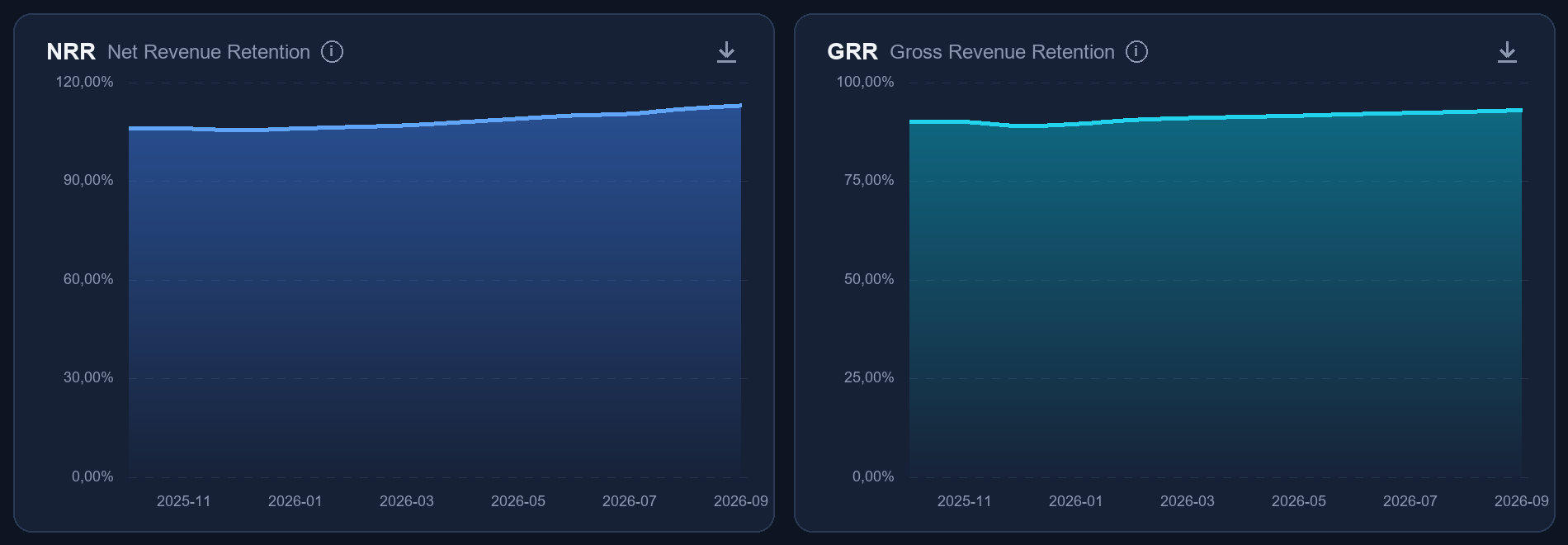
Above 100% your revenue grows without a single new customer joining. Expansion at existing customers offsets everything that leaks away and more. Sales then build on a base that rises by itself.
Exactly 100% means your base sustains itself. All growth comes from new sales.
Below 100% your new sales first have to close the leak before any growth is left. At 90% you lose a tenth of your base each year before you begin. That is workable, but it means your acquisition machine has to run structurally harder to reach the same result, and acquisition gets more expensive, not cheaper.
What counts as a good NRR varies strongly by type of business and by customer segment. A model with many users per customer has more room to expand than a model with one fixed rate. So compare your NRR above all with your own NRR from last quarter, not with a number you read somewhere on a blog.
NRR and GRR
Alongside NRR there is GRR: Gross Revenue Retention. The same formula, but without the expansion.
GRR
GRR = (starting MRR − contraction − churn) ÷ starting MRR
In the example above: (126,000 − 4,900 − 11,800) ÷ 126,000 = 87%.
GRR is by definition never higher than 100%. It measures purely how much you hold on to, without growth at happy customers being able to prettify the picture.
The difference between the two is informative. Here: 98% NRR against 87% GRR. That gap of eleven points means you have a solid expansion engine offsetting a sizeable leak. As long as that engine runs, nothing is wrong. The moment it falters, that leak suddenly becomes visible, and by then it has already been there for a year.
Report them together
Showing only NRR is the most flattering version of the truth. The gap with GRR is exactly the figure an investor is looking for.
Why you do not get this out of Exact Online
All the building blocks of NRR are in your accounting. The customers are in there, the amounts are in there, the movements are in there. And yet the number does not come out.
That is because NRR is not a property of one booking, but of a comparison between two moments for the same group. You have to:
- Establish which customers were there on the start date, a snapshot that is kept nowhere.
- Find that same group twelve months later, including those who have since left.
- Determine per customer whether the amount has become higher, lower or zero, and classify that difference as expansion, contraction or churn.
- Consistently keep new customers out of it, in all four terms.
Step 1 is the hardest, and the reason most businesses get stuck here. An accounting system keeps bookings, not a historical composition of your customer base. If you want to calculate NRR over last year, you have to reconstruct that composition from the movements, and that only works if someone recorded neatly every month who was in it at the time.
Anyone who never started on that cannot calculate NRR retroactively. That is not an arithmetic problem but a memory problem.
The practical route
Start today by recording your MRR per customer, per month. One line per customer per month, with the normalised monthly amount. You need no more than that.
Twelve months from now you can then calculate NRR without reconstructing anything. If you do not, the question "what is your NRR?" is still unanswerable a year from now, and that is exactly the question that will be asked then.
Where this fits
NRR is one of the terms you use to talk about subscription revenue, alongside MRR, churn, ARPA, LTV and cohorts. None of them is complicated, and they are distinct enough from each other to be precise.
What they have in common is that none of them is in your bookkeeping, for the same reason every time: your accounting records what has happened, not what is happening. That distinction is the subject of the whitepaper The blind spot in Exact Online.
Read on: The blind spot in Exact Online
The whitepaper is online ungated, without registration. Read or download it, and afterwards you will know whether your revenue line hides a blind spot.