LTV is the metric that most easily impresses and most easily misleads. One customer is not worth €300 but €35,000, says the formula, and suddenly every acquisition euro is defensible. That is sometimes true. But the sum underneath rests on three assumptions rarely made out loud, and the moment one of them wobbles, your whole business case tilts.
The formula
LTV stands for Customer Lifetime Value: the revenue a customer generates over their entire lifetime with you. The most common form is a division.
LTV (simplified)
LTV = ARPA ÷ customer churn
If you calculate per month, a lifetime in months comes out. Keep the unit consistent: a monthly churn in an annual formula gives a number that means nothing.
ARPA is your average recurring revenue per customer (how you calculate it is covered in this article), customer churn is the share of your customers who leave per period.
Why that division works: if you lose 2% of your customers each month, a customer stays on average 1 ÷ 0.02 = 50 months. Multiply that by what they bring in per month, and you have their lifetime revenue.
A worked example
| Ingredient | Value |
|---|---|
| ARPA | €699 per month |
| Customer churn | 2% per month |
| Average lifetime | 50 months |
| LTV (revenue) | €34,950 |
On paper every customer is worth almost €35,000. That is the number that ends up in the pitch. And it is, as it stands, too high. For three reasons.
Three assumptions that inflate the number
Assumption 1: churn stays constant
The formula assumes today's 2% also holds four years from now. But churn is rarely flat. New customers drop off faster than loyal ones (which is exactly what a cohort analysis shows). If you calculate with your average churn, you calculate with a number pressed down by your old, stable customers, and you overestimate the lifetime of the customer you win today.
Assumption 2: revenue is not value
€34,950 is revenue, not profit. A customer who brings you €699 a month but costs €400 a month in hosting, support and service is not worth €34,950 but about €15,000. Without gross margin, LTV is a revenue number with an expensive-sounding name. So always multiply by your margin:
LTV (margin-adjusted)
LTV = (ARPA × gross margin) ÷ customer churn
At 45% gross margin: (€699 × 0.45) ÷ 0.02 = €15,728 per customer.
Assumption 3: a euro in four years is not a euro today
Revenue that only comes in in year four is worth less than revenue from this month, if only because you do not have it yet. For a quick internal check you may ignore that. For a funding round or a valuation you may not: then a discount rate belongs on top of it, and your LTV drops further.
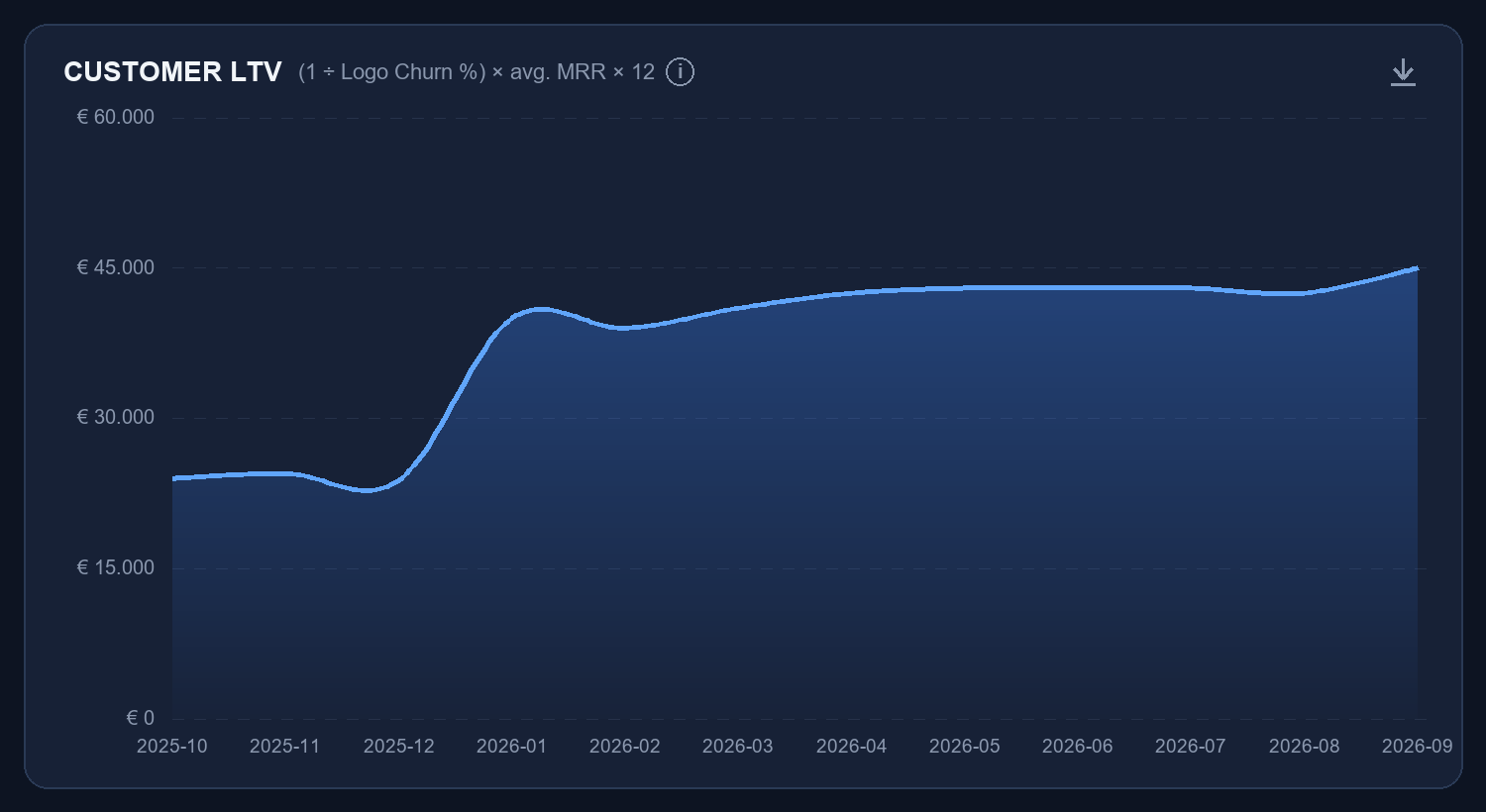
Where LTV becomes a steering figure: alongside CAC
LTV on its own tells you what a customer is worth. It does not tell you whether you win them profitably. For that you set it against your CAC (Customer Acquisition Cost), what it costs to acquire a customer. The LTV / CAC ratio is the number that really matters:
- Below 1: you pay more for a customer than they will ever bring in.
- Between 1 and 3: you earn them back, but little is left to grow on.
- 3 or higher: a healthy ratio, each customer comfortably funds the next.
And the payback period, CAC divided by (ARPA × margin), tells you how many months you have to wait before a customer has paid themselves back.
Here lies the very problem most tools do not solve. LTV you can get from your revenue side. CAC you cannot: it sits in your marketing and sales costs, on the other side of your bookkeeping. A tool that only sits on your invoicing knows your income and not your costs, so it can show you LTV but not LTV / CAC.
Per cohort and per segment, not as one number
As with ARPA, one LTV across your whole base hides more than it shows. Two things make it usable:
- Per segment. If you sell to a small and a large customer group, one average LTV is a fiction no real customer resembles. Two LTVs steer an acquisition decision, one does not.
- Per cohort. Calculate the actually accumulated revenue per cohort instead of the formula. That is slower (you have to wait until a cohort has really run off) but it is the only LTV that does not rest on an assumption, and the measure against which you can check your formula LTV.
Why this does not roll out of Exact Online
Every ingredient of LTV is a derivative, not a booking. ARPA asks for your MRR divided by your active customers. Churn asks for a comparison between two months. Margin asks for your cost side too. And the honest variant, LTV per cohort, asks for a series of monthly snapshots of your customer base that your accounting does not keep.
Your bookkeeping records what a customer has paid. It does not record what they are worth, because value is not an event but an expectation, built from a handful of numbers none of which appear on an invoice.
That distinction, between what your accounting records and what your business needs to know, is the subject of the whitepaper The blind spot in Exact Online.
Read on: The blind spot in Exact Online
The whitepaper is online ungated, without registration. Read or download it, and afterwards you will know whether your revenue line hides a blind spot.